Showing posts with label #Nepal. Show all posts

Wednesday, March 23, 2016

Dhirdo Power 24 Hour?!

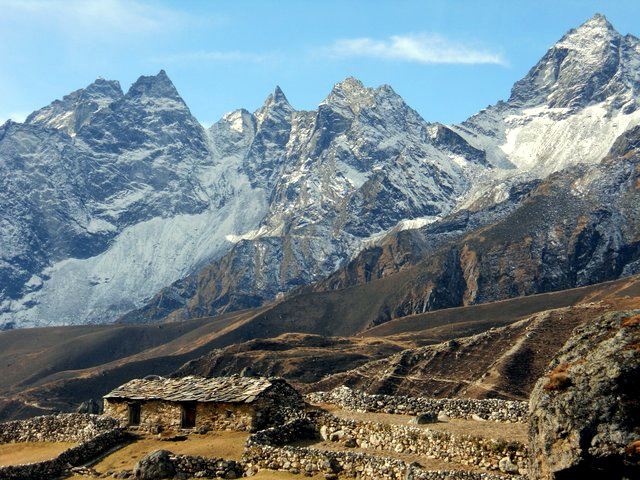
Photo by A. Lyons in Rukum, part of Nepal's wild, wild west
Savor a heaping taste of quintessential Nepali fare... beyond daal-bhat tarakari which is a heaping plate of rice with lentil soup and curried vegetables is a lesser know but equally delicious, Nepali dish known as dhirdo . 

Dhirdo is a heaping plate of puréed corn or millet mash typically served with lentil soup and curried vegetables (ingredients for dhirdo and daal-bhat-tarkari are locally sourced and farm fresh).

Accompany the tasty Himalayan fare with a classic Nepali beverage...chiyaa (sweet black or milk tea); fermented spirits include chyang (not distilled) and raksi (distilled) from locally grown maize, rice, millet and sometimes fruit...indispensable for entertaining guests (including you?!)

If you would like to savor your own plate of Himalayan fare and enjoy a mug or two of local spirits along with it, then please contact a Himalayan specialist soon at neohorizontravels@gmail.com.

Upcoming departures in the nirvana of Nepal include the following and more: 


Photo by A. Lyons in Rukum, part of Nepal's wild, wild west

#dhirdo #dalbhat #Nepal 

Sunday, March 20, 2016

Yeti Exposed (story link)


Photo by Alonzo Lyons
Please enjoy   Cracking the Yeti Myth , the latest feature in ECS Nepal magazine, 13 March 2016.

The talented Raz Thapa of Imagine Web Solution created the galumphin’ yeti of Neo Horizon Travels' logo.

If you are inspired to join a quest for the yeti in Nepal’s highlands, then please contact a Himalayan specialist at neohorizontravels@gmail.com

Keep on trekking, keep on enjoying the wonders of the Himalayan paradise of Nepal. The following are two of the most tantalizing options for chasing yeti's larger than life footsteps:


Photo by Alonzo Lyons

#Pleistocene #yeti #bigfoot #sasquatch #nepal #himalaya

Thursday, March 17, 2016

Island Peak (Imja Tse) -- your first Himalayan mountain?

Photo by Alonzo Lyons
Read about Climbing Island Peak at the following link, written by *yours truly* for Adventure Travel, the UK’s leading adventure magazine, Issue #108, November/December 2013:

Climbing Island Peak

Typically, Island Peak (6,189 m / 20,305 ft) can be summited with less than a week's addition to the Everest Base Camp Trek or other famous treks in world famous Sagarmatha National Park.

Want to try climbing a 6000+ M (20,000+ ft) Himalayan peak? If you are inspired to tackle tantalizing Island Peak (Imja Tse) and more in Nepal’s Khumbu Region (and beyond) then please contact a Himalayan Specialist now at neohorizontravels@gmail.com and find more details at www.neohorizontravels.com

Photo by Alonzo Lyons
Adventure is calling from Nepal…and Neo Horizon Travels is in the Himalaya waiting to answer that call to adventure with you. Give them a try -- I am sure that you will be satisfied with your experience in Nepal and their professional services.
Climbing Island Peak (Adventure Travel, #108, November/December 2013)

#trekkingpeaks #nepal #climbing #neohorizon

Tuesday, March 15, 2016

Great Himalayan Fairy Tale (REDUX)

 (Advisory: The following is a critical and hopefully realistic assessment--don't mind--with the intention of holding aid entrepreneurs' feet to the fires while they meddle in foreign lands with large sums of money and leverage, little oversight and few to no language and culture skills--unfortunately, a lethal recipe that leads to suffering for the common people while the interlopers enjoy a lifestyle in the top echelons of society) 
Photo by Alonzo Lyons
I am certainly not the only one who sees the Great Himalayan Trail Trick(?) to be a well-funded, Himalayan snow job. Although, I might be one of the few Himalayaphiles willing to call it out publicly (many others have shared their disbelief with me in private), especially in the face of a moneyed industry that has grown up around the fictional line on a map. A corps of well-paid and articulate people have worked feverishly to will the very concept into being with exuberant energy and talent despite Himalayan obstacles and Himalayan chasms and a lack of a any semblance of a contiguous trail.

Even the talented gentleman who wrote the eponymous guidebook makes a striking confession. In his Acknowledgements he mentions the three Sherpa guides who made it possible by joining him 'every step of the way'. 


Three Sherpa?!

Ever step of the way?!

This is a skilled, veteran trekker with many seasons of experience in the highlands of Nepal. If he needed three Sherpa guides every step of a cross-country journey to find the way, negotiate logistics and technical sections, in other words, survival, then what hope is there for the average trekker to pick up a guidebook and go?


In fact, an elite, world-class trail runner tried just that and was dangerously off course within days, losing personal items and forced to return to Kathmandu by vehicle, perhaps lucky something worse did not happen.

Again, if an elite, battle-hardened trail runner was immediately lost, then what hope is there for the average trekker?
Photo by Alonzo Lyons
"One Trail to Rule Them All" was a slogan put forth with a grandiose, kingly name at a time when Nepal had just ousted a 239 year-old tyrannical crown--perhaps a more appropriate motto during that dynamic time might have been One Trail to Unite Nepal or even The Trail to Unite Them All. After all, the country was just out of a ten-year civil war and working to come together as a newly born democratic republic. Yet, even my above alternate names would miss the mark considerably until there actually is a trail. 

There is no one such trail or even a contiguous series of trails to venture cross-country in any sort of efficient way. If a person is lucky and with adept guides and tremendous logistical and technical gear and support (arranged with a great amount of funds), then they might be able to trek across the country from the eastern to western border, but certainly not on any singular trail, or even one contiguous route linking trails. There simply are not trails linking other trails in a number of remote areas even as maps might hazardously make it seem unless some very lengthy detours and wild zig-zags are undertaken to connect sections (such detours are not indicated on any of these maps).


Photo by Alonzo Lyons
Moreover, the seasonal window for crossing secluded, technical, mountain passes on a cross-country high traverse is relatively short and through isolated, rugged, uninhabited highland areas along the ramparts of the Himalaya. Spending time in this no-man's land at altitude including traversing technical passes requires not only the aforementioned expert guides with technical skills but a good deal of supporting gear and food as well as staff to help with both and not just route-finding. Certainly, such an expedition-style journey is outside the ken and budget of casual trekkers and most veteran trekkers for that matter.

Additionally, there is no Lower GHT. It is simply a conceptual line on a map, and I personally know the two guys who casually placed that line on a map. They did it from an office in inner-city Kathmandu far away from any remote trails. One of them never trekked in his life, the other manages a company that specializes in taking foreigners to Annapurna, Langtang and Everest and did no recce whatsoever in the majority of the country. 


Please don't get me wrong. People have hiked cross-country, and of course that is totally possible. Some people did near cross-country walks decades before the 'launching' of this posh project, but no one has hiked the so-called Lower GHT route because it  simply does not exist (the highly sponsored and talented group who hiked border-to-border followed a myriad of trails and not an advertised route). 

To the credit of SNV (the Dutch INGO that funds along with help from DFID, the aid wing of the United Kingdom, the heavy promotion and dazzling salaries of a multitude of people both foreign and domestic working on promoting the GHT fantasy), they have retreated from 'One Trail to Rule Them All' realizing at least that the initial slogan was a total fiction, although it is astonishing that the motto was vetted in the first place with the many paid experts that were on board.

Photo by Alonzo Lyons
Further retreats have been made, yet whatever the amorphous conception has been molded into at this point, with all due respect, the cash-infused notions of the GHT and Lower-GHT are nothing like the names suggest. I humbly request that people affiliated with the swanky campaign might reconsider associating their good names with it no matter what the financial rewards might be.

At this point, with all due respect, great Himalayan truth needs to surpass all else now more than ever as Nepal re-builds post-quake and I/NGOs and government agencies, agents, and accomplices might do well to consider a new, more transparent paradigm. If nothing else, then do it for the safety of trekkers who might be fooled into attempting a long-haul hike on a non-existent route.

Follies like this prompted a Nepali journalist to cry out, "Does Nepal need DFID or does DFID need Nepal?!" It is a fair enough question, especially for a citizen of a country burdened by indefinite 'aid'. Nepali journalists should turn the heat up on interlopers by continuing to ask valid, hard-hitting questions of these outsiders meddling in their homeland and demand credible, evidence-based answers to their operations as well as a time frame for withdrawal.

Notwthstanding humanitarian quake relief, Nepalis might do very best with the opportunity to choose their own programs and own targets without outside intervention that often enables dysfunctional elements of the status quo and therefore, empowers and embeds the wrong people while dis-empowering and disenfranchising the 
citizenry through mis-governance and paralyzing entitlements. 

Removing the deadweight, malignant establishment players and entities will be the best anyone could possibly imagine for development in Nepal. It would allow the Nepali people the chance to follow their own dreams with their own capabilities and efforts unencumbered by donors, diplomats, politicians and an entitled gang.

Many cheers for your patience and consideration regarding my comments above. Please keep on trekking, sightseeing and adventuring in Nepal, an outdoors paradise offering endless cultural and natural treasures along with a legendary hospitality that will charm visitors to this enchanting Himalayan Nirvana. And to the misguided of the aid workers, donors and I/NGO staff who've traveled overseas to change a society, please give renewed consideration to the trekker's maxim, "The Himalaya might change you, please don't change the Himalaya."
Photo by Alonzo Lyons
#DonorDarlings, #globaldev, #deadaid, #myGHTbs, #AidBully #Nepal #trekNepal #Himalaya

Saturday, February 6, 2016

Nepal -- All-Season Paradise

From ECS magazine's February 2016 Edition, Nepal's All-Season Bounty:

"Nepal is a festive country with fascinating traditions, lifestyles, and natural treasures from cities to remote rural destinations. It is most famous as a boundless outdoor paradise. Starting with luxuriant greenery of the lowlands to fertile hills surrounded by emerald and golden paddy fields and dense forests on up to arid highlands surrounded by peaks spiraling into the skies. The country is wide open to outdoor activities in all seasons. The hospitable population offers plenty of chances to get involved, or just observe cultural traditions and festivals. From culture to all-out adventure, and everything in between, whatever a visitor might be looking for, Nepal is an all-season destination."

If you would like to join a trek of a lifetime in this Himalayan Paradise, please contact the Himalaya Specialists of Neo Horizon Travels. Cheers and keep on trekking and enjoying the outdoor life.


#Nepal #himalayaphile, 

Wednesday, February 3, 2016

Trek Nirvana

Adventure is calling in the Nirvana of Nepal's Himalaya for the trekking experiences of a lifetime. Trekking in Nepal's Himalaya can give the feeling of trekking in Nirvana. 

Come visit Nepal's Himalaya, come trek Nirvana -- more info on Nepal's Himalayan Paradise at Neo Horizon Travels.

#Nirvana #Nepal #Himalaya #Paradise


Tuesday, February 2, 2016

Nirvana Nepal

Aum Mani Padme Hum -- a renowned Tibetan mantra for 'the jewel is in the lotus'  -- varying interpretations of the meaning include enlightenment (the jewel) is right here on earth (the lotus). 

The trekking parody version of this mantra is, "Oh, Mommy Take Me Home." It is time to come home to Nepal's Nirvana, home to the Himalaya, home to hospitality, cultural and natural treasures and heaps of adventure, exploration and genuine smiles.... 

Come find a bountiful slice of Nirvana in Himalayan paradise.  

Neo Horizon is here to guide you on the trekking adventure of a lifetime; we are sure that you will be satisified with the experience and our services as you rediscover your smile and rejuvenate your spirit.  Aum Mani Padme Hum...Oh, Mommy Take Me Home, home to Nirvana Nepal.


#trekking #Nirvana


Saturday, January 23, 2016

Truffles in the Himalaya?

Prabesh Roka and Dr. Raj Tripathi are risking five years of hard work on truffle cultivation in Nepal. Truffles are edible subterranean fungi worth their weight in gold. They have set up experimental plots near Thabang village of Rolpa District. Thabang is a picturesque, remote settlement in western Nepal that experienced some of the heaviest fighting during the ten-year revolution (1996-2006). Other than an attempt at high-end agriculture, there is little driving the subsistence economy in Thabang. Tourism is slowly picking up in the enchanting hamlet on the southern fringes of the Guerrilla Trek and Yarsagumba (Cordyceps) Trails. A few hardscrabble travelers trickle through now and again.

The Himalayan gamble might pay off lavishly. Visionary innovation is deserving of a country with the world’s highest and most dazzling peaks…and the far-western roxy (moonshine) is unbeatable.

Please find more about their attempts at cultivating Himalayan truffles in Nepal in a feature story at the following link: HImalayan Truffles by Alonzo Lyons, ECS Magazine, 15 January 2015 (http://ecs.com.np/features/himalayan-truffles).

Cheers and keep on trekking!


Tuesday, January 19, 2016

the most important factor for lifting people out of poverty...

“The problem of poverty is not a shortage of experts. It’s a shortage of rights....the most important factor in lifting people out of poverty is allowing free markets and entrepreneurship to flourish...when there's an environment of universal rights for poor people, for citizens of a society, then that does indeed make technical solutions happen."

Tuesday, November 24, 2015

All Nepal for All Nepalis -- 'The Time has Come'

"Nepal is not here to satisfy your saviour-complexes or act out your political adventures. Colonial lords should know this." Tweet by Rubeena Mahato, 19th November 2015
https://twitter.com/rubeenaa/status/667346976187351040

Indefinite aid is not in the best interests of Nepal. Nepal needs less foreign interference (from both near & afar). After nearly six decades, isn't it time to consider phasing out foreign aid schemes run by people non-fluent in language and culture?

Time for all of Nepal for all Nepalis.

The Time Has Come
A Fact's a Fact
It Belongs to Them
Let's Give it Back
--from Beds Are Burning, protest song by the Aussie band Midnight Oil

Rockabilly cover of Beds Are Burning 

Sunday, November 8, 2015

Baltimore Sun Throwing Shade on Nepal

Cheers for the coverage of Nepal (Another Crisis Looms for Nepal, Balitmore Sun, 2nd November, 2015). With all due respect to the esteemed author, it seems more a weakly disguised plea for donations than a news piece about Nepal.

Nepal needs less foreign interference (from entities both near and far) not more. Perhaps commerce and business can be given a chance in lieu of indefinite aid which entrenches the wrong people and contributes to the country’s endless political and economic woes.

Aid has not only dis-empowered people but has damaged the country's ethos while endowing a privileged gang with unmerited entitlements. Decades of aid interference has left Nepal (and many other developing economies) without measurable progress on economic development and without reduction of poverty among other critical metrics.

Aid entrepreneurs tend to (knowingly and most often unknowingly) abet dysfunctional elements of society and that keeps the citizens oppressed and without an opportunity to pursue their own talents and dreams.

Regarding the earthquakes over five months ago, only a relative fraction of Nepal was severely affected then, and the worst hit areas have been and are receiving attention. Unfortunately, earthquake relief has become another political game. An unsatisfactory constitution was rushed through by a ruling establishment motivated by ‘aid’ funds dangled as a carrot—that is, foreign interference (despite good intentions) played an unsavory role, and it led to an eruption of protests backed by India and a supply crisis in urban areas of Nepal, most significantly Kathmandu…although the well-looked-after aid entrepreneurs are not likely to feel the pinch relative to most Nepali people.

Another bone of contention with this story, I don’t know of any “high altitude areas” requiring “delivery of urgently required supplies such as food and shelter materials” before being “cut off with the onset of winter”. In fact, I cannot think of any villages at all throughout Nepal that might be “impossible to access” unless an ungodly amount of snow fell.

Even then, if such villages do exist, and if there is some unexpected heavy snow early in winter that temporarily blocks trails to villages that implausibly do not have enough supplies to cover for a few days, then, in that extremely unlikely scenario, helicopters are the logical delivery means for urgent supplies until trails re-open within days.

Alarming stories and photos are damaging one of the largest and most hardworking industries of Nepal, tourism. The tourism industry can immediately benefit Nepal and the many people who rely on if for work rather than the very few who rely on the top-heavy donor industry (which tends to support only the wealthy ruling elite). Continued tales of disaster and crisis are turning tourists away unnecessarily. Most if not all of post-quake Nepal is open for tourism and has been for a long time. The people are ready and eager to receive visitors.

In my humble reckoning, it seems foreign interference is a cause of many of the difficult issues that Nepal faces including lack of preparedness for a natural disaster -- a result of a lack of development and progress for the foreseeable past in spite of nearly six decades of ‘aid’ and over 50,000 I/NGOs now operating in country…instead of a nation dazzling like Norway or Switzerland, it is wallowing in troubles...and that begs the question...what are tens of thousands of I/NGO’s doing in Nepal? Transparency is paramount, especially in dysfunctional systems...can these I/NGO's reveal their operations, pay scales and data regarding their activities?

All the while, most aid entrepreneurs enjoy a lifestyle in the upper crust of Nepali society (despite claims of hardship) and reside in luxuriant housing, often with servants, and revel in posh comforts not dreamed of by the majority of Nepalis. Most aid workers are enjoying high-living at the very top economic echelon of Nepal. Even more curious, most do not have local language and culture skills for the country that they are working in.…giant, red flags all around for those wishing to operate in a place that has for decades ranked in the bottom tiers of transparency and corruption indices.

Simply put, despite the best of intentions, aid agents tend to endow dysfunctional elements of society including the ruling establishment and a privileged gang with unmerited entitlements. That tends to prolong the very issues ‘aid’ aims to serve--severely hampering issues of development and progress--with fatal results for the disenfranchised population.

To these INGO’s, please cease and desist. Quitting Nepal might be the very best thing imaginable right now for the benefit of the honest, hardworking people of Nepal. Or, if you absolutely must do something, if you cannot resist traveling overseas to effect change in a faraway land, then only try to clean up governance and not abet and endow dysfunction directly and mostly indirectly. With a decent government, then the people of Nepal will be free to do for themselves what aid aims to do for them. Better yet, leave this beautiful and tender culture and its people alone. Focus on the home front and the (many) problems closer to your own homes. Cheers and good-speed. Come back soon as a tourist to enjoy the endless natural and cultural wonders of Nepal and help uplift the economy the right way.

As a side note, the Tharu ethnicity, mentioned in the Baltimore Sun story do not have “close ties with India”. Tharu are considered to be an indigenous, malaria resistant people of the jungle plains. They have a distinct culture, traditions and lifestyle and they identify very little with India. The Madhesi do tend to have ties to India but by no means “occupy the bottom rungs of Nepali society”. Many top political posts have been filled by Madhesi people including Ram Baran Yadav, president of Nepal from July 2008 to October 2015.
Delivering 'aid' to a developing economy is about as precarious as crossing the log bridge pictured above--better not to try. Photo by Alonzo Lyons

Thursday, November 5, 2015

"Nepal is in crisis, and it has nothing to do with the earthquake"

Nepal identifies culturally with India much less than might be suspected especially while nationalistic and devout Hindu Narendra Modi is at the helm of its meddling neighbor, The hills people of Nepal have a distinct culture, traditions and lifestyle, including the janajati Tamang, Magar, Gurung, Rai, Limbu, Kami, Tharu and other ethnicities such as the Sherpa, Thakali, Manangi and Bhotiya with origins and close ties to Tibetan culture. All of these aforementioned groups identify little with India.

The groups that potentially identify with Indian culture have a growing disgust towards outside interference. Modi has blundered here, and China is stepping in to the void on Nepal’s request. At the very least, opening supply lines to the north for landlocked Nepal will increase flexibility.

That said, the energy crisis is mainly in urban areas, especially Kathmandu Valley. In rural areas, people rely much less on cooking gas, petrol and products from India.

Still the many aid organizations headquartered in the valley seem to want not for resources that the majority of citizens have been suffering for. These aid entrepreneurs are enjoying a lifestyle in the upper crust of society as they impinge upon Nepali society in petrol guzzling SUV’s, reside in luxuriant housing, often with servants, and enjoy posh comforts not dreamed of by most Nepalis. Still, they claim hardship while enjoying high-living at the top economic echelon of Nepal.

Notwithstanding the protests raging in the plains and the Indian embargo, foreign agents are a key component of the problem that has Nepal teetering on the brink of failed state status and lacking in development and progress for the foreseeable past. Aid agents tend to endow dysfunctional elements of society including much of the ruling establishment and a privileged gang with unmerited entitlements.

Decades of interference by foreign agents including an indefinite aid paradigm has damaged Nepal severely--most significantly by keeping the wrong people in power while aid agents try to cover for a broken system (despite the best of intentions, many aid workers operate without local language skills and are blind to local culture).

Banning INGOs might greatly assist in pulling the financial carpet out from under the deadweight, malignant political establishment and that might be the best anyone could possibly imagine for development. That might allow the honest, hardworking Nepali people the freedom to pursue their own dreams with their own capabilities and efforts unencumbered by donors, diplomats, politicians, an entitled gang and meddling countries near and far.

Indian embargo has led to a fuel crisis in Kathmandu Valley. Commuters riding atop minivan, photo by Alonzo Lyons
Lumbini, Nepal, birthplace of Siddhartha Gautama, later known by the title of Buddha. Photo by Alonzo Lyons